
Explore Zambia's most
            comprehensive Travel Guide


Zambia Tourism Board       


HOME

.
  HIGHLIGHTS
   Victoria Falls
   The Zambezi River
 
   Lake Kariba  
   Lake Tanganyika  
  
More...

  GAME PARKS
   South Luangwa
   North Luangwa
   Lower Zambezi
   Kafue 

   Lochinvar
   Sioma Ngwezi
   Kasanka
   More ....

 SAFARIS
    Walking Safaris
 
 Birding Safaris
   
Canoeing Safaris
 
 Mobile Safaris
   
Elephant Back Safaris
  
Horse Back Safaris
  
Photographic Safaris
 
 Open Vehicle Safaris

  ADVENTURE /SPORT
   
White Water Rafting
    Bungi Jumping
    River Boarding
  
 Tandem Kayaking
   
Abseiling
   
Gorge Swinging
   
House Boating
    Tiger and Fly
Fishing
   
Lion Walks
    Cheetah Walks
   
Elephant back Trails
    Driving around

  CITIES & TOWNS
    Lusaka
 
 Livingstone  
  
The Copperbelt  
 
 More

  DIRECTORY
    Accommodation
   
Adventures
    Embassies
    Golf Courses
   
Govt Offices
    Private Reserves
    Restaurants-Lusaka
    Safari Operators

    Transportation
    Tours
    Travel Agents
     

  TRAVEL INFO
  
Quick Facts
  
Getting There
   
Getting Around
   Handy Information
  
Visa Info  
 
  WILDLIFE

  
 Illustrated Checklists

  BIRDLIFE
  
 
In depth synopsis
   
Checklists

 PEOPLE
   History
  
Culture
  
Major Tribes
  
Ceremonies 


  ENVIRONMENT
   Geography
  
Vegetation
  
Conservation
 

  MAPS
  PHOTO GALLERIES
  VIDEOS
  TOUR & SAFARI Co's
  LINKS
  ENQUIRIES

  ADVERTISING


TRADITIONAL CEREMONIES


TABLE OF CEREMONIES . . . . . . . THE PEOPLE OF ZAMBIA

There are more than 20 annual traditional ceremonies in Zambia, manifesting customs, social life, rituals, oral history, material and spiritual culture and if you have the opportunity to attend one, do. They provide a valuable insight to a traditional culture that has been passed down from generation to generation.

The decline of traditional customs and culture has been brought about by the infiltration of the west and western ways and the melting pot of various tribes living in the same areas. There has recently been a realisation of the value of traditions and a conscious effort is being made to preserve them

Most of the ceremonies have a deep meaning, in many cases designed to invoke memories of the transformation from childhood to adulthood. Most tribes in rural areas still practice harmless initiation ceremonies for girls which are generally conducted after puberty. They are intended to help the girls make the transition from childhood to womanhood and prepare them for marriage. Only a few tribes still practice male circumcision initiation ceremonies and those that occur happen in total secrecy.

The open ceremonies that visitors can watch are those that signify ancient times, when new kingdoms were being founded by ancient chiefs and are usually splendid, colourful affairs with much symbolism in their dancing and drumming.

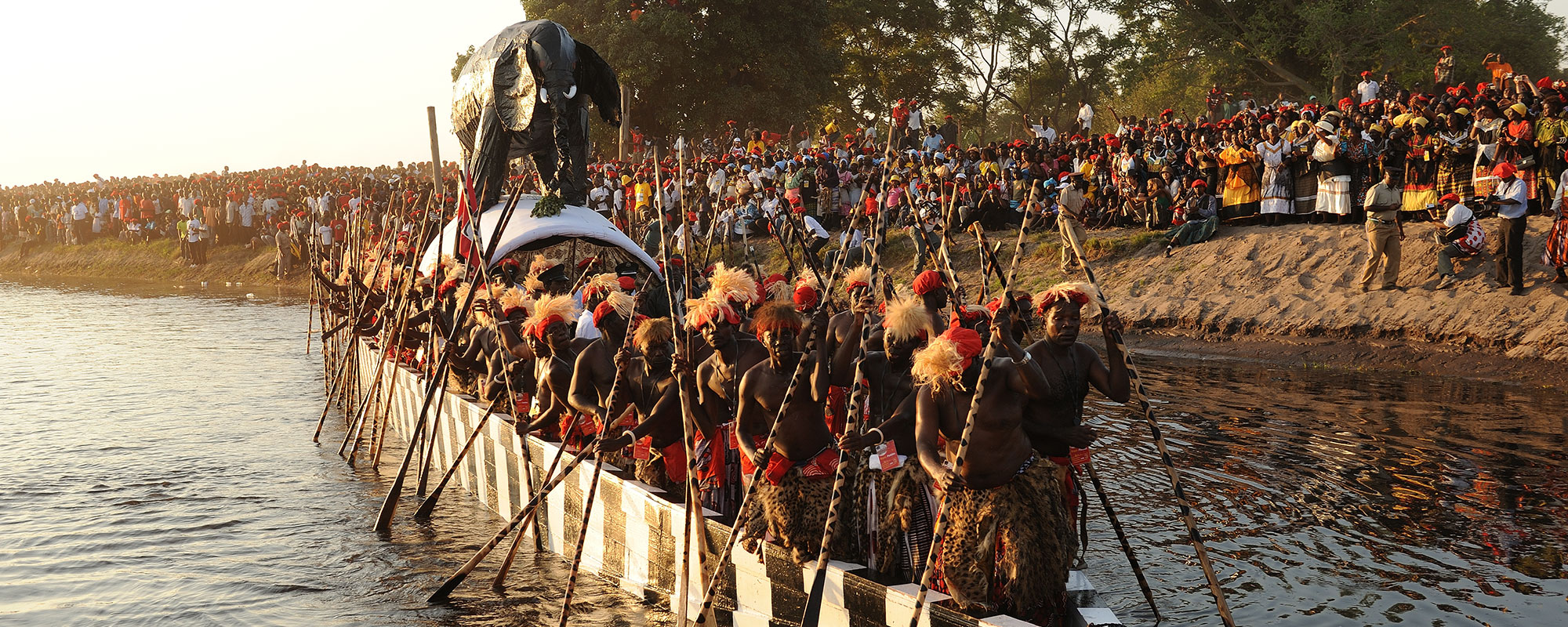
    The Ku-omboka

The name means "to get out of the water onto dry ground". Every year towards the end of the rainy season as the flood plain of the upper Zambezi valley rises, the Lozi people make a ceremonial move to higher ground. When the Chief decides that it’s time to leave (anytime from February to May), the drums signal to all the people. They pack their belongings into canoes and the whole tribe leaves en mass.


The chief in his barge with his family and a troop of traditionally dressed paddlers, in the lead. It takes about six hours to cover the distance between the dry season capital Lealui, and the wet season capital Limulunga. There the successful move is celebrated with traditional singing and dancing. This ceremony dates back more than 300 years when the Lozi people broke away from the great Lunda Empire to come and settle in the upper regions of the Zambezi. The vast plains with abundant fish was ideal for settlement but the annual floods could not be checked, so every year they move to higher ground until the rainy season passes.


  The Umutomboko

The celebration is an annual reminder of the victories of Chief Mwata Kazembe, when his great kingdom migrated en masse into Luapula from the Congo earlier this century. Legend has it, the dispersal began when the kingdom’s paramount chief, Mwata Yamva ordered his people to build a tower which would reach the sky so that they could bring him the sun and the moon. The tower collapsed during vain attempts to build it, killing many of the builders and causing many of the families to flee in terror. Under the leadership of Kazembe, they travelled away across the river and into the east conquering nearly all the tribes they encountered. Each time they conquered a people, they celebrated the victory which they called Umutomboko.

The two day ceremony is a grand affair, mixed with ritual, semi-mystic performance, pounding drum beats and long speeches. Tributes of beer and food are brought to the chief by the women and the chief, smeared with white powder, then goes to pay homage to his ancestral spirits and is carried back to his palace to the beating of drums.

On the second day, a goat is slaughtered before the Mutomboko dance led by the chief. At the climax of the ceremony, the chief takes his sword in his hand and points it in all directions, implying that there is nobody who can conquer him except God, as he points upwards. He then points down to indicate his place of rest when he dies.
The brightly coloured cotton skirts worn by the chiefs and senior council are in memory of an early king who received gifts of cloth from Portuguese ambassadors.

More info at this website

   The Shimunenga

Shimunenga is considered by the Ba-ila people of Maala to be a Divine Being to be approached when the crops need blessing, the cattle are to be taken to the plains or when a murder is committed. The Shimunenga Ceremony is the time for the people to thank their god for providing for them over the period which has just passed. The ceremony takes place once a year between September and November at the close of the old year and the beginning of the new. It lasts for 3 days and takes place at the home of the Ba-ila of Maala.
 

Zambia culture and tradition - Shimunenga ceremony


  The Nc’wala

The Nc’wala ceremony involves Paramount Chief Mpezeni dressed in leopard skin re-enacting an old tradition which has roots in early Zulu culture. The Chief must taste the first fruits of the land, (usually maize, sugarcane and pumpkin). The King must then experience a ritual rebirth which involves home confinement for a period of time before the blessing of the fruits.

Zambia culture and tradition - Nc'wala ceremony


   Likumbi Lya Mize

The Makishi masquerades are very popular in Zambia and are displayed with pride at the Likumbi Lya Mize ceremony on the last weekend of August every year. The Makishi come from a tradition of boys initiation in which moral lessons are imparted and practical life lessons to young boys between 8 and 12 are given. It now extends into a four day ceremony starting on a Wednesday and climaxing on a Saturday. The event takes place on both sides of the Zambezi and has vibrant market stalls where baskets, metalwork, traditional fabric and carvings can be bought. Masked dances and theatrical performance take place throughout the days and the meanings of the masks are shared with onlookers. The entertainment is non stop and various activities which visitors can witness take place over the four day periods. The traditional dress is fascinating as are the range of artefacts on display. The ceremony climaxes on Mize day on the Saturday with a royal Makishi parade for the Chiefs.

Check with the Zambia Tourism Board, for the exact dates each year


TABLE OF TRADITIONAL CEREMONIES

DISTRICT

TRIBE

CEREMONY

MONTH

Mkushi

Bisa/Swaka/Lala

Inchibwela Mushi

September

Chibombo

Lenje

Kulamba Kubwalo

October

Mumbwa

Kaonde

Musaka/Jikubi

September

Mumbwa

Kaonde/lla

Likumbi Lyamalumbe

October

DISTRICT

TRIBE

CEREMONY

MONTH

Masaiti

Lamba

Chabalankata

November

Mpongwe

Lamba

Chitentamo/Nsengele

November

DISTRICT

TRIBE

CEREMONY

MONTH

Chipata

Ngoni

N’cwala

February 

Katete

Chewa

Kulamba

August

Petauke

Nsenga

Tuwimba

October

Mambwe

Kunda

Malaila

October

Chama

Tumbuka

Kwenje

October

DISTRICT

TRIBE

CEREMONY

MONTH

Samfya

Ng’umbo

Kwanga

Octobe

Chienge

Shila

Mabila

October

Kawambwa

Lunda

Umutomboko

July

Chienge

Bwile

Bwile

September

Kawambwa

Chishinga

Chishinga Malaila

October

Mansa, Milenge and Chembe

Ushi

Chabuka Baushi

October

Mansa

Ushi

Makumba

August

DISTRICT

TRIBE

CEREMONY

MONTH

Luangwa

Nsenga-Luzi

Mbambala

November

Chinyunyu

Soli

Chibwela Kumushi

November

Kafue

Goba

Kailala

September

DISTRICT

TRIBE

CEREMONY

MONTH

Mungwi

Bemba

Ukusefya Pa Ng’wena

August

Mpika

Bisa

Chinamanongo

September

Luwingu

Bemba

Mukulu Pembe

August

Isoka

Tumbuka

Vikamkanimba

September

Isoka

Namwanga

Ng’ondo

November

Isoka

Mfungwe

Chambo Chalutanga

September

Nakonde

Namwanga

Mulasa

September

Chilubi Island

Bisa

Chisaka Chalubombo

September

Mpika

Bisa

Bisa Malaila

September

Mbala

Mambwe / Lungu

Mutomolo

June

DISTRICT

TRIBE

CEREMONY

MONTH

Mwinilunga

Lunda

Chisemwa Cha Lunda

August

Kasempa

Kaonde

Nsomo

June

Solwezi

Kaonde

Kupupa

July

Zambezi

Lunda

Lunda Lubanza

August

Kabompo

Mbunda

Lukwakwa

October

Mufumbwe

Kaonde

Makundu

August

Kabompo

Luchazi

Chivweka

June

Kabompo

Mbunda

Mbunda Liyoyelo

October

Solwezi

Kaonde

Kunyanta Ntanda

July

Mufumbwe

Kaonde

Ntongo

September

Solwezi

Lamba

Kuvuluka Kishakulu

September

Solwezi

Kaonde

Kufukwila

May

Zambezi  Luvale  Likumbi Lya Mize    August

Solwezi

Kaonde

Lubinda Ntongo

August

DISTRICT

TRIBE

CEREMONY

MONTH

Livingstone

Toka Leya

Lwiindi

January

Monze

Tonga

Lwindi Gonde

July

Kalomo

Tonga

Chungu

October

Kalomo

Toka Leya

Lukuni Luzwa buuka

August

Kalomo

Tonga

Maanzi Aabila Lwiindi

 October

DISTRICT

TRIBE

CEREMONY

MONTH

Senanga

Lozi

Kuomboka Nalolo

May

Kalabo

Lozi

Kuomboka Libonda

May

Kaoma

Nkoya

Kazanga

July


Back to People of Zambia Page


Ceremony
Celebrating Zambia's Cultural Heritage

by

Tamara Guhrs
and
 Mulenga Kapwepwe

 This book contains a wealth of information about traditional ceremonies
 on the Zambia calendar, spread over 200 pages of spectacular photography
and informative text.

To order click here


Google

VIDEOS
with short clips on
safaris, wildlife,
Victoria Falls,
adventures and more

CLICK HERE
for the Tourist Board
Video on Zambia


GALLERIES
Photo Gallery Pages
by destination,


BROCHURES

*
Destination Zambia

* Zambia Highlights

 * Tourism Investment
Opportunities in the
 Kafue National Park


TOURS & SAFARIS
Book accommodation
 or a guided tour
anywhere in Zambia


Follow us on


Designed and hosted
by